Advanced Settings
The Advanced settings section contains powerful features for AI-powered document redaction and security configurations. These settings can impact GDPR compliance - proceed with caution.
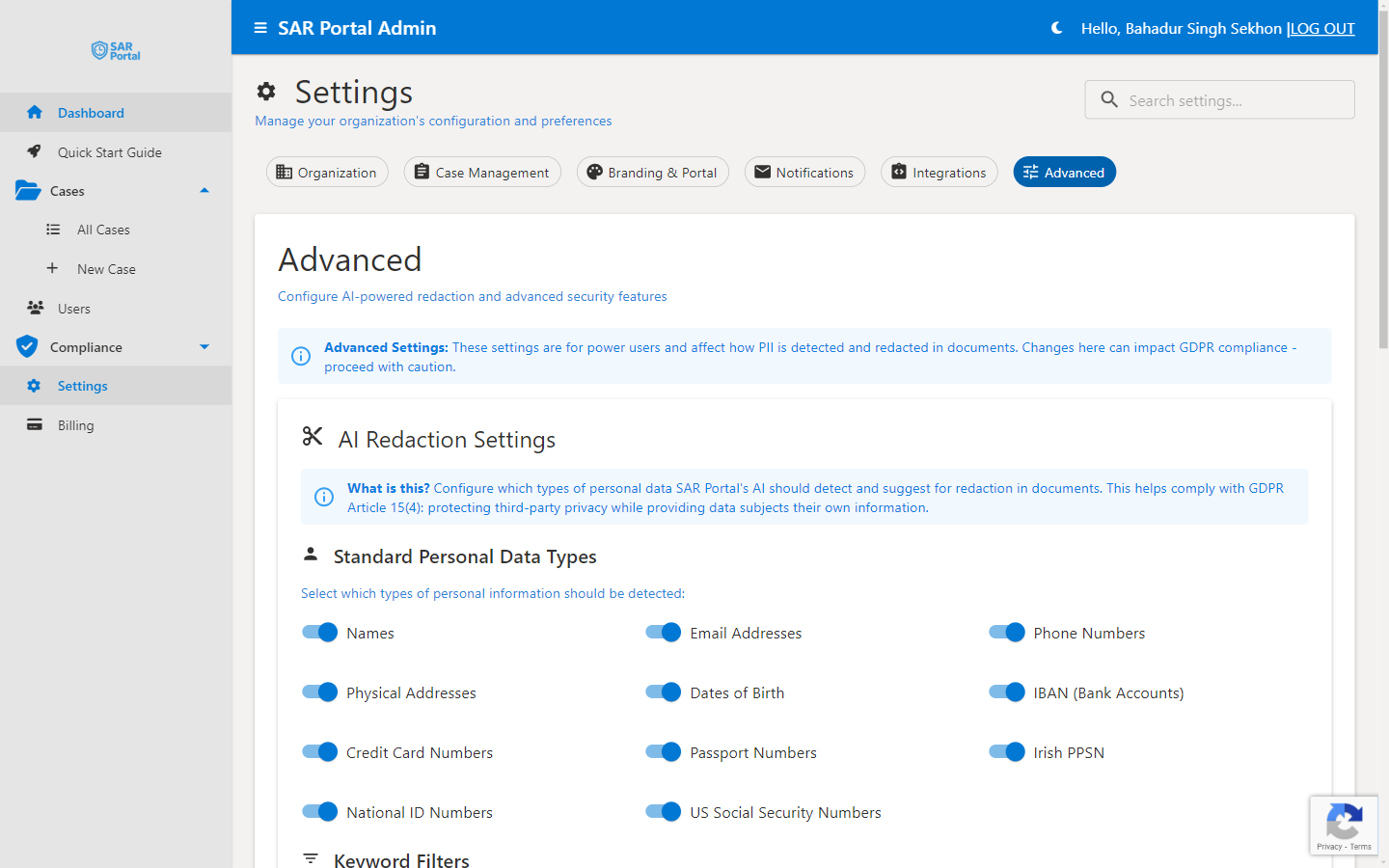
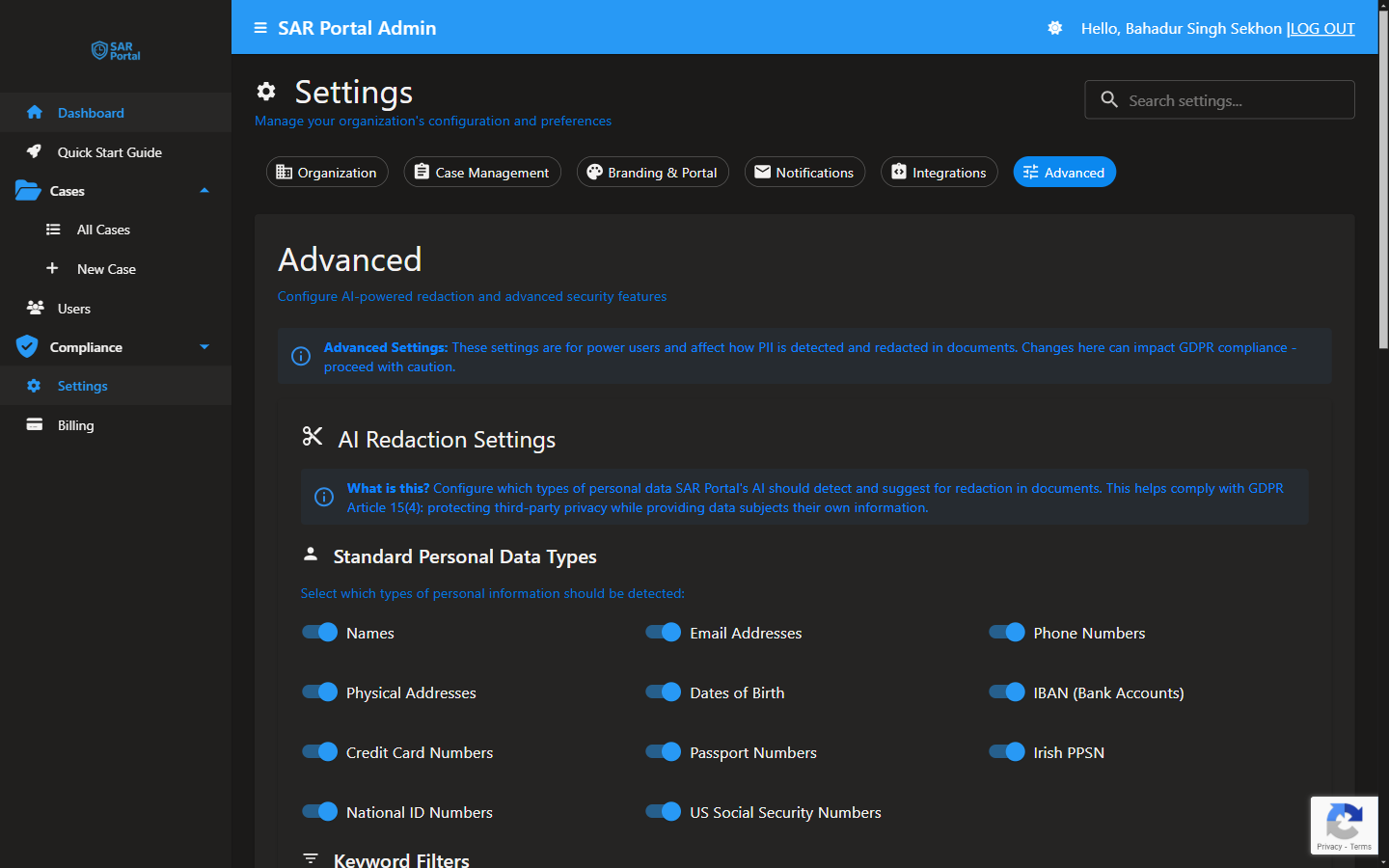
Like all Settings, this tab is for Admins only. Click Save Settings at the bottom of AI Redaction Settings to keep your changes.
AI Redaction Settings
What Is AI Redaction?
SAR Portal’s AI automatically detects and suggests redaction of personal data in documents. This helps comply with GDPR Article 15(4): protecting third-party privacy while providing data subjects their own information.
How It Works
- Upload documents to a case
- AI scans for personal information
- Detected PII is highlighted for review
- You approve or reject suggested redactions
- Clean copies are generated for disclosure
Standard Personal Data Types
Configure which types of personal information the AI should detect:
Identity Information
| Data Type | Description | Default |
|---|---|---|
| Names | Full names, first/last names | Enabled |
| Email Addresses | Email addresses in any format | Enabled |
| Phone Numbers | Phone numbers in various formats | Enabled |
| Physical Addresses | Street addresses, postal codes | Enabled |
| Dates of Birth | Birth dates in various formats | Enabled |
Financial Information
| Data Type | Description | Default |
|---|---|---|
| IBAN (Bank Accounts) | International bank account numbers | Enabled |
| Credit Card Numbers | Credit/debit card numbers | Enabled |
Government Identifiers
| Data Type | Description | Default |
|---|---|---|
| Passport Numbers | Passport document numbers | Enabled |
| National ID Numbers | National identification numbers | Enabled |
| Irish PPSN | Irish Personal Public Service Numbers | Enabled |
| US Social Security Numbers | US SSN format | Enabled |
Enabling/Disabling Detection
- Go to Settings > Advanced
- Toggle each data type on or off
- Click Save Settings
Disabled types won’t be flagged for redaction.
Detection Sensitivity
PII Detection Sensitivity Slider
The PII Detection Sensitivity slider (Minimum Confidence) runs from 50% to 95% in steps of 5. It sets the minimum confidence score an item needs before it appears in your redaction results, and it also decides which kinds of personal data are detected: higher values focus on core identity data only, lower values cast a wider net.
Pick one of the Quick presets by use case, or drag the slider:
| Preset | What is detected |
|---|---|
| Core PII Only (85%) | Names, emails, phone numbers, addresses and government IDs only. Suits utility bills, invoices and low-sensitivity documents |
| Balanced (75%) | Default and recommended. Core PII plus bank details (IBAN, sort codes, credit cards), dates of birth and credentials |
| Thorough (60%) | Balanced plus organisations, job roles (such as manager or customer), dates, IP addresses and financial references. Good for HR and legal files |
| Maximum Coverage (50%) | Every PII type, adding medical conditions, travel information, vehicle registrations and device identifiers |
Any value from 85% upwards behaves like Core PII Only, 70% to 80% like Balanced, 60% to 65% like Thorough, and 50% to 55% like Maximum Coverage. The box under the slider describes what the current setting detects.
Always Redact and Never Redact Lists
Two keyword lists give you direct control over what is and isn’t redacted, overriding the AI’s judgement:
Always Redact (Deny List)
Keywords entered here are always redacted whenever they appear in a document — useful for company-specific terms, project code names, or sensitive category words the AI might not recognize as personal data.
Never Redact (Allow List)
Keywords entered here are never redacted, even if the AI flags them — useful for your own organization name, public product names, or terms that should always remain visible.
Custom Business Identifiers
Beyond the standard PII types, you can add custom regular-expression (regex) patterns to detect business-specific identifiers — for example internal customer reference numbers, account codes, or policy numbers in a known format.
How do I add a custom PII detection pattern?
- Go to Settings > Advanced
- Find the Custom Business Identifiers section
- Click Add Pattern
- Enter a Pattern Name and a Regex Pattern (e.g.
\bCUST-\d{6}\b), and optionally a Description (optional) and Example Values (optional) - The dialog checks the regex for valid syntax and for catastrophic backtracking; its Add Pattern button stays disabled until the pattern passes
- Click Add Pattern in the dialog, then Save Settings at the bottom of AI Redaction Settings. The pattern is applied to new redaction runs alongside the standard detectors
Custom patterns run inside SAR Portal and use no AI allowance. Each saved pattern has an Enabled switch, so you can turn it off without deleting it.
Tier Limits
The number of custom patterns you can save depends on your plan:
| Plan | Custom Patterns |
|---|---|
| Basic | 2 |
| Starter | 5 |
| Pro | 10 |
| Enterprise | No limit |
Redaction Options
These toggles control how documents are processed and what is produced:
| Option | Default | What It Does |
|---|---|---|
| Upload redacted PDF only (never upload original) | On | The unredacted original is never uploaded to cloud storage; only its file hash is logged for the audit trail |
| Import email attachments as separate case files | On | When an email (.eml or .msg) is uploaded, its attachments become separate case documents and are redacted alongside the email. Files that cannot be opened, such as password-protected PDFs, are included as-is. Turn it off if you supply attachments separately; the redacted email still lists the attachment file names. Applies from your next upload |
| Skip inline signature images from emails | Off | When on, small images in an email body (signature logos, icons, tracking pixels) are not imported as separate case documents. Real attachments are not affected |
Redaction Mode
Choose a Mode under Redaction mode:
| Mode | Behavior |
|---|---|
| Standard — detect and redact personal data (recommended) | Scans uploaded documents for personal data and lets your team review and redact before sharing (default) |
| Convert only — no in-app redaction | Skips PII detection entirely and uses no AI allowance. Emails are still converted to a viewable PDF; all other files are included as-is. Choose this only if you redact outside SAR Portal |
With Convert only, documents are delivered to the data subject without SAR Portal removing third-party personal data, so your own process must handle redaction.
Per-Upload Override
Allow per-upload redaction override is off by default. When on, your team sees a Skip redaction for this upload switch on the upload screens and can override the mode above for a single upload, in either direction: skip redaction under Standard, or redact a specific upload under Convert only.
Best Practices
Start with Defaults
The default detection settings work well for most organizations. Only disable types if you have a specific reason.
Test Before Production
After changing settings:
- Upload a test document
- Review AI detections
- Verify correct behavior
- Adjust as needed
Regular Review
- Review AI accuracy periodically
- Adjust the sensitivity slider based on results
- Update your deny/allow lists and custom patterns as needed
Document Your Choices
Keep records of:
- Why certain types are disabled
- Your deny/allow list entries and custom patterns, and their purpose
- Any non-default settings
Troubleshooting
Too Many False Positives
If the AI flags too much:
- Raise the sensitivity slider toward Balanced (75%), or Core PII Only (85%) if you can accept that bank details and dates of birth will no longer be detected
- Disable irrelevant data types
- Add over-flagged terms to the Never Redact (Allow List)
Missing Detections
If the AI misses PII:
- Lower the sensitivity slider toward Thorough (60%) or Maximum Coverage (50%)
- Ensure the data type is enabled
- Add the term to the Always Redact (Deny List), or create a Custom Business Identifier pattern
- Contact support for pattern updates
Performance Issues
Large documents may process slowly:
- Normal for documents with many pages
- Processing happens in background
- Status shows in document list
Danger Zone
Below the redaction settings, the Danger Zone has a Delete Account button: “Permanently delete your organization and all associated data”. It opens the account deletion page, where you confirm the deletion. See Account Deletion before you use it.
Related Settings
| Section | What It Does |
|---|---|
| Case Management | Configure request types, statuses, and retention |
| Integrations | Public portal URLs and External Systems |
| Organization | Company profile settings |
| AI-Powered Redaction | How redaction works on your documents |